MODEFIELD
Shape resonances beyond the limits of a physical body.
- Engine
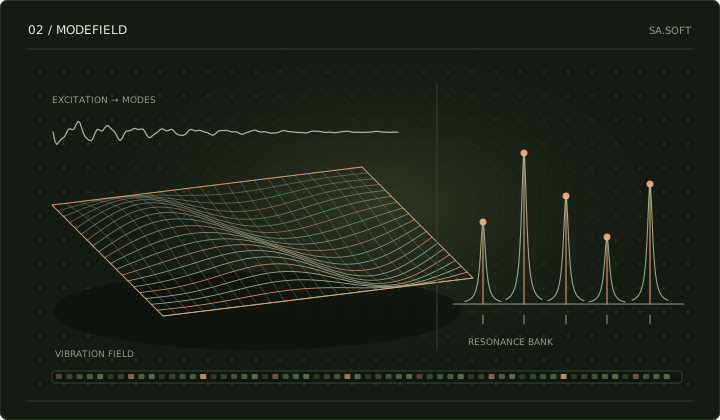
- A bank of decaying resonators
- Working environment
- Format: VST3 / AU
- Closed beta
- A working beta of the modal engine. The editor interface and resonance-set format are still evolving.
Musical objective.
An editor for decaying resonant modes. Instead of choosing a preset instrument, the composer sets the frequencies, decay, and strength of individual components.
Capabilities.
- An editor for mode frequencies, levels, and decay times
- Excitation by impulse or external sound
- Smooth blending between the outputs of two resonator sets
Signal path.
Engineering trade-off.
The model describes individual resonances. It does not derive a response from body geometry or automatically reproduce nonlinear material behavior.
From studio practice.
Works with sound: excites digital resonators.
MODEFIELD began alongside HALO as an editor for digital decay. A specific set of frequencies and decay times was needed in place of a generic “ceramic” preset. The same approach later proved useful for NACRE’s strings and TESSERA’s wooden bars: a familiar source can excite an entirely different digital response.
How the method works
Each mode is described by its frequency, level, and decay time. After a brief excitation, its amplitude decreases, and the sum of the modes forms the overall sound. In the current version, transitions between two profiles are made by blending their outputs: frequencies need not glide into one another. A profile does not calculate an object’s shape or automatically model collisions, cracks, or strong nonlinearities.
One working approach.
Record a single strike on HALO’s wall with the digital extension switched off.
Assemble a small set of audible components and adjust their relative levels.
Lengthen some of the decay times, then compare the dry sound and the blended result at the same loudness.
What is saved with the project
A profile contains mode parameters, the excitation method, input normalization, and information about the source object. Changing the sensor position or suspension changes the excitation; the old profile remains an artistic choice, not a new measurement-based model.